AI Coding Tools

Explore the best AI Coding Tools — independent reviews, comparisons, pricing and step-by-step how-to guides, curated by Aizhi.

  • Apache Kudu

    Apache Kudu

    Apache Kudu is a free and open source column-oriented data store of the Apache Hadoop ecosystem. It is compatible with most of the data processing frameworks in the Hadoop environment. It provides completeness to Hadoop's storage layer to enable fast analytics on fast data. The open source project to build Apache Kudu began as internal project at Cloudera. The first version Apache Kudu 1.0 was released 19 September 2016. == Comparison with other storage engines == Kudu was designed and optimized for OLAP workloads. Like HBase, it is a real-time store that supports key-indexed record lookup and mutation. Kudu differs from HBase since Kudu's datamodel is a more traditional relational model, while HBase is schemaless. Kudu's "on-disk representation is truly columnar and follows an entirely different storage design than HBase/Bigtable".

    Read more →
  • Stanhope Demonstrator

    Stanhope Demonstrator

    The Stanhope Demonstrator was the first machine to solve problems in logic. It was designed by Charles Stanhope, 3rd Earl Stanhope to demonstrate consequences in logic symbolically. The first model was constructed in 1775. It consisted of two slides coloured red and gray mounted in a square brass frame. This could be used to demonstrate the solution to a syllogistic type of problem in which objects might have two different properties and the question was how many would have both properties. Scales marked zero to ten were used to set the numbers or proportions of objects with the two properties. This form of inference anticipated the numerically definite syllogism which Augustus De Morgan laid out in his book, Formal Logic, in 1847. == Construction == The device was a brass plate about four inches square which was mounted on a piece of mahogany which was three-quarters of an inch thick. There was an opening with a depression in the wood about one and a half inches square and half an inch deep. This opening was called the holon, meaning "whole", and represented the full set of objects under consideration. A slide of red translucent glass could be inserted from the right across the holon. A slide of gray wood could be slid under the red slide. When the device was used for the "Rule for the Logic of Certainty", the gray slider was inserted from the left. When it was used for the "Rule for the Logic of Probability", the gray slider was inserted from above. The red and the gray sliders represented the two affirmative propositions which were being combined. Stanhope called these ho and los. At least four of the devices with this square style were built. In 1879, Robert Harley wrote that he had one which he had been given by Stanhope's great-grandson, Arthur, who had kept one. The other two were owned by Henry Prevost Babbage – the son of Charles Babbage, who continued his work on the Analytical Engine. One of the devices was donated to the Science Museum, London by the last Earl in 1953. Other styles, such as circular models, were constructed, but these were less convenient.

    Read more →
  • Grok sexual deepfake scandal

    Grok sexual deepfake scandal

    From 2025 onwards, X (formerly Twitter)'s integrated chatbot, Grok, has allowed users to nonconsensually alter images of individuals, including minors, to show them in bikinis or transparent clothing, or in sexually suggestive contexts. The majority of these prompts were targeted at women and girls. Users were able to generate such images by responding to a photo with a request to Grok, such as "put her in a bikini", to which the chatbot would publicly reply with a generated image. The scandal drew significant criticism from lawmakers across the world, and there were calls for bans on X, as well as legal crackdowns on X and xAI for, amongst other reasons, the facilitation of sexual abuse, revenge porn, and child pornography. == Background == Deepfake pornography emerged in the late 2010s with the advent of machine learning. Originally, it was created on a small individual scale using a combination of machine learning algorithms, computer vision techniques, and AI software. However, the production process has significantly evolved since 2018, with the advent of several public apps that have largely automated the process. Since 2023, several AI apps available on Google Play and the Apple App Store are capable of "nudify-ing" user provided photos to generate non-consensual deepfake pornography. Grok would first be proposed by Elon Musk in 2023, when he expressed an intention to create his own AI chatbot to "combat bias". Grok version 2.0, released on August 14, 2024, would introduce image generation capabilities, ones which would be improved over successive updates. == Grok deepfake generation == Cases of Grok being used to remove the clothes from women in pictures, replacing them with bikinis or lingerie, began to surface in May 2025. By late December 2025, a trend of X users requesting such edits to women's photos without permission had taken root, and this received significant media attention in the first few days of January 2026. Some users prompted Grok to edit photos of women into sexualized poses, and others to add blood and bruising, with the chatbot publicly posting these graphic images in response. Grok's X account was restricted on January 9 from posting image generation responses to users who are not paid subscribers, providing a link to "subscribe to unlock these features". All users were still able to generate Grok-altered images using X's "Edit image" feature, and the standalone Grok website and app. However, by March 19, Grok’s Imagine feature was fully restricted to paid subscribers only (SuperGrok tier) for both the standalone Grok website and mobile app. == Analysis == An analysis of 20,000 images generated by Grok between December 25, 2025, and January 1, 2026, showed 2% appeared to be 18 or younger, including 30 of "young or very young" women or girls in bikinis or transparent clothes. A Reuters review of Grok requests over 10 minutes on January 2nd found 102 attempts to put women in bikinis. A separate analysis conducted over 24 hours from January 5 to 6 calculated that users had Grok create 6,700 sexually suggestive or nudified images per hour — 84 times more so than the top 5 deepfake websites combined. Wired reported that far more graphic AI-generated sexual imagery was being created by Grok on its website and app, which are separate to X, including female celebrities removing their clothes and engaging in sexual acts. An analysis of 800 pieces of recovered content by the Paris-based nonprofit AI Forensics found that almost 10% were "instances of photorealistic people, very young, doing sexual activities". AI-generated deepfakes have been described as sexual assault, and as a means to push women out of the public sphere. AI-generated sexually explicit or exploitative image claims are now being treated more like product safety or personal injury harms, not just privacy violations. Because harm may occur the moment an image is generated, some plaintiffs argue liability should focus on the system’s design and safety safeguards. == Reactions == On January 15, the Get Grok Gone campaign delivered letters to Apple and Google, demanding the removal of the app from Apple Store and Google Play Store respectively. The campaign accused both companies of profiting from nonconsensual intimate imagery and child sexual abuse imagery, which were also banned by the companies own policies. The Get Grok Gone campaign argues that the restrictions placed on Grok by xAI are not enough and that Apple and Google are enabling the distribution of harmful material by hosting the apps. === Elon Musk and xAI === xAI responded to requests for comment from media organizations with the automated reply, "Legacy Media Lies." On January 2, Elon Musk reacted "Not sure why, but I couldn’t stop laughing about this one 🤣🤣" to an image of a toaster dressed in a bikini by Grok. Later, on January 14, Elon Musk said that he was "not aware of any naked underage images generated by Grok. Literally zero." Later that same day, xAI announced that X users will no longer be able to use Grok to alter images of real people to portray them in revealing clothing. However, verified X users, as well as users of the standalone Grok app and website, were still able to generate such images. ==== Elon Musk's family ==== Ashley St. Clair, mother of one of Elon Musk's children, reported that Grok users were creating fake sexualized images from her photos, including a photo of her as a child. She considers the photos to be a form of revenge porn, and considered suing under the Take It Down Act. A spokesperson for X stated, "We take action against illegal content on X, including child sexual abuse material (CSAM), by removing it, permanently suspending accounts, and working with local governments and law enforcement as necessary. Anyone using or prompting Grok to make illegal content will suffer the same consequences as if they upload illegal content." However, Grok continued to post non-consensual sexual images. On January 15, St. Clair filed a lawsuit against xAI in the New York Supreme Court. === Canada === In response to the Grok deepfake scandal, individuals have asked that the government of Canada boycott X. On January 10, 2026, Canadian MP and Minister of AI Evan Solomon declared that Canada "is not considering a ban on X". In April 2026, Bill C-16, An Act to amend certain Acts in relation to criminal and correctional matters (child protection, gender-based violence, delays and other measures), was amended following a proposal by Conservative MP Andrew Lawton to ensure that AI-generated images and "nearly nude" intimate images are criminalized. A further proposal by NDP MP Leah Gazan to encompass "sexualized or humiliating contexts, such transparent bathing suits or being covered in blood or bruises" was voted down. === France === On January 2, 2026, French ministers reported the AI tool to prosecutors, calling the content "manifestly illegal", and also asked regulators to check compliance with the Digital Services Act. On February 3, Paris prosecutors office, a cybercrime team employed by them and Europol searched the Paris offices of X. The investigation started as one into allegations of abuse of algorithms and fraudulent data extraction, but has expanded into spreading Holocaust denial and sexual deepfakes. Elon Musk and former CEO Linda Yaccarino have been summoned to a hearing on April 20, with other X staff as witnesses. On April 20, Musk did not turn up for the hearing. The Paris prosecutors office told the BBC on April 20 that it had "taken note of the absence of the people summoned", adding "the presence or absence (of the people summoned) is not an obstacle to continuing the investigation". === India === Indian Member of Parliament Priyanka Chaturvedi filed a complaint to India's IT ministry, demanding a review of Grok's safety mechanisms. === Indonesia === On January 10, Indonesia announced that Grok will be temporarily blocked, becoming the first country to do so. Meutya Hafid, the Minister of Communication and Digital Affairs, stated that "the government views the practice of non-consensual sexual deepfakes as a serious violation of human rights, dignity, and the security of citizens in the digital space." Access to Grok in the country was later restored on February 1. === Ireland === On January 6, Coimisiún na Meán, the Irish media commission, said they were consulting with the European Commission about concerns that Grok was generating sexualized images of women and children. The same day, Ofcom of the United Kingdom contacted X concerning complaints about these images. On January 13, Micheál Martin, Taoiseach of Ireland, announced he would talk with Rossa Fanning, the country's Attorney General, about the Grok chatbot being used to produce sexually explicit images of women and minors. On January 14, the Garda Síochána announced there are 200 investigations into child sex abuse images generated by Grok. The Garda National Cyber Crime Bureau has al

    Read more →
  • With Folded Hands ...

    With Folded Hands ...

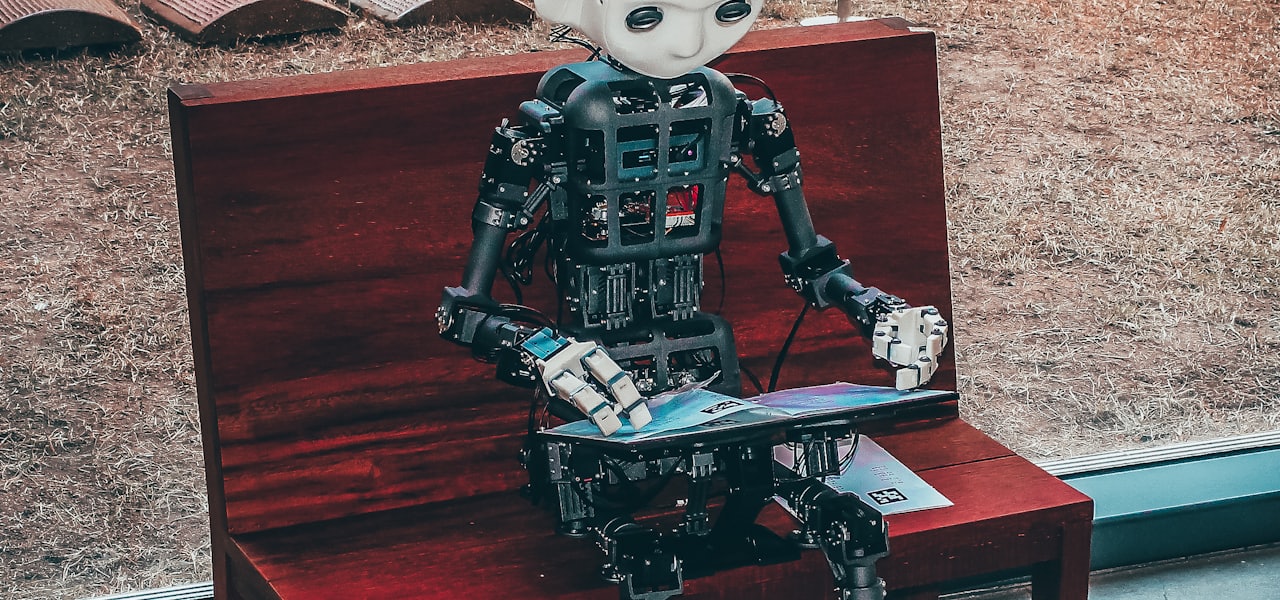
    "With Folded Hands ..." is a 1947 science fiction novelette by American writer Jack Williamson (1908–2006). In writing it, Williamson was influenced by the aftermath of World War II, the atomic bombings of Hiroshima and Nagasaki, and his concern that "some of the technological creations we had developed with the best intentions might have disastrous consequences in the long run." The novelette first appeared in the July 1947 issue of Astounding Science Fiction and was later included in The Science Fiction Hall of Fame, Volume Two (1973) after being voted one of the best novellas up to 1965. In 1950, it was the first of several Astounding stories adapted for NBC's radio series Dimension X. == Rewrite and sequel == The 1947 publication was followed by a novel-length rewrite, with a different setting and inventor. At the behest of Astounding editor-in-chief John W. Campbell, a new ending had the robots defeated by means of what Williamson and Campbell would later christen "psionics". This novel was serialized, also in Astounding (March, April, May 1948), as ... And Searching Mind, and finally published in hardback book form as The Humanoids (1949). Much later, in 1980, Williamson followed with another sequel, The Humanoid Touch. == Plot summary == Underhill, a seller of "Mechanicals" (unthinking robots that perform menial tasks) in the small town of Two Rivers, is startled to find a competitor's store on his way home. The competitors are not humans but are small black robots who appear more advanced than anything Underhill has encountered before. They describe themselves as "humanoids". Disturbed at his encounter, Underhill rushes home to discover that his wife has taken in a new lodger, a mysterious old man named Sledge. In the course of the next day, the new Mechanicals have appeared everywhere in town. They state that they only follow the Prime Directive: "to serve and obey and guard men from harm". Offering their services free of charge, they replace humans as police officers, bank tellers, and more, and eventually drive Underhill out of business. Despite the humanoids' benign appearance and mission, Underhill soon realizes that, in the name of their Prime Directive, the mechanicals have essentially taken over every aspect of human life. No humans may engage in any behavior that might endanger them, and every human action is carefully scrutinized. Suicide is prohibited. Humans who resist the Prime Directive are taken away and lobotomized, so that they may live happily under the direction of the humanoids. Underhill learns that his lodger Sledge is the creator of the humanoids and is on the run from them. Sledge explains that 60 years earlier he had discovered the force of "rhodomagnetics" on the planet Wing IV and that his discovery resulted in a war that destroyed his planet. In his grief, Sledge designed the humanoids to help humanity and be invulnerable to human exploitation. However, he eventually realized that they had instead taken control of humanity, in the name of their Prime Directive, to make humans happy. The humanoids are spreading out from Wing IV to every human-occupied planet to implement their Prime Directive. Sledge and Underhill attempt to stop the humanoids by aiming a rhodomagnetic beam at Wing IV, but fail. The humanoids take Sledge away for surgery. He returns with no memory of his prior life, stating that he is now happy under the humanoids' care. Underhill is driven home by the humanoids, sitting "with folded hands," as there is nothing left to do. == Origins == In a 1991 interview, Williamson revealed how the story construction reflected events of his childhood in addition to technological extrapolations: I wrote "With Folded Hands" immediately after World War II, when the shadow of the atomic bomb had just fallen over SF and was just beginning to haunt the imaginations of people in the US. The story grows out of that general feeling that some of the technological creations we had developed with the best intentions might have disastrous consequences in the long run (that idea, of course, still seems relevant today). The notion I was consciously working on specifically came out of a fragment of a story I had worked on for a while about an astronaut in space who is accompanied by a robot obviously superior to him physically—i.e., the robot wasn't hurt by gravity, extremes of temperature, radiation, or whatever. Just looking at the fragment gave me the sense of how inferior humanity is in many ways to mechanical creations. That basic recognition was the essence of the story, and as I wrote it up in my notes the theme was that the perfect machine would prove to be perfectly destructive... It was only when I looked back at the story much later on that I was able to realize that the emotional reach of the story undoubtedly derived from my own early childhood, when people were attempting to protect me from all those hazardous things a kid is going to encounter in the isolated frontier setting I grew up in. As a result, I felt frustrated and over protected by people whom I couldn't hate because I loved them. A sort of psychological trap. Specifically, the first three years of my life were spent on a ranch at the top of the Sierra Madre Mountains on the headwaters of the Yaqui River in Sonora, Mexico. ... [My mother] was terrified by this environment. My father built a crib that became a psychological prison for me, particularly because my mother apparently kept me in it too long, when I needed to get out and crawl on the floor. ... In retrospect, I'm certain I projected my fears and suspicions of this kind of conditioning, and these projections became the governing emotional principle of "With Folded Hands" and The Humanoids. == Reception == In 2024, Robert Silverberg wrote an essay in which he asserted that "With Folded Hands..." is "probably the best story ever written about robots" and suggested that Elon Musk's Optimus Generation 2 is the realization of the "humanoids" along with their worst drawbacks.

    Read more →
  • Hugging Face

    Hugging Face

    Hugging Face, Inc., is an American company based in New York City that develops computation tools for building applications using machine learning. Its transformers library built for natural language processing applications and its platform allow users to share machine learning models and datasets and showcase their work. == History == === Founding === The company was founded in 2016 by French entrepreneurs Clément Delangue, Julien Chaumond, and Thomas Wolf in New York City, originally as a company that developed a chatbot app targeted at teenagers. The company was named after the U+1F917 🤗 HUGGING FACE emoji. After open sourcing the model behind the chatbot, the company pivoted to focus on being a platform for machine learning. === AI boom === On April 28, 2021, the company launched the BigScience Research Workshop in collaboration with several other research groups to release an open large language model. In 2022, the workshop concluded with the announcement of BLOOM, a multilingual large language model with 176 billion parameters. In February 2023, the company announced partnership with Amazon Web Services (AWS) which would allow Hugging Face's products to be available to AWS customers to use them as the building blocks for their custom applications. The company also said the next generation of BLOOM will be run on Trainium, a proprietary machine learning chip created by AWS. In June 2024, the company announced, along with Meta and Scaleway, their launch of a new AI accelerator program for European startups. The initiative aimed to help startups integrate open foundation models into their products, accelerating the EU AI ecosystem. The program, based at STATION F in Paris, ran from September 2024 to February 2025. Selected startups received mentoring, and access to AI models and tools and Scaleway's computing power. On September 23, 2024, to further the International Decade of Indigenous Languages, Hugging Face teamed up with Meta and UNESCO to launch a new online language translator. It was built on Meta's No Language Left Behind open-source AI model, enabling free text translation across 200 languages, including many low-resource languages. In April 2025, Hugging Face announced that they acquired a humanoid robotics startup, Pollen Robotics, based in France and founded by Matthieu Lapeyre and Pierre Rouanet in 2016. In an X tweet, Delangue shared his vision to "make Artificial Intelligence robotics Open Source". === Cyberattacks === In early 2026, hackers hijacked the Hugging Face platform to launch Android-targeted attacks involving "powerful malware" which could completely take over a compromised target.

    Read more →
  • Pippit

    Pippit

    Pippit (Chinese: 小云雀; pinyin: Xiǎoyúnquè) is an artificial intelligence content creation platform developed by the Chinese technology company ByteDance. The platform, powered by CapCut leverages multimodal AI technology to streamline professional-grade video and image production, specifically targeting small and medium-sized enterprisesand social media creators. == History == In May 2025, ByteDance officially launched Pippit, which is positioned as an AI video and picture creation tool. In early 2026, Pippit underwent a major architectural overhaul with the integration of the Dreamina seedance 2.0. This technical milestone introduced the "Short Drama Agent" functionality, which enables the end-to-end conversion of scripts up to 100,000 words into fully rendered video productions.

    Read more →
  • Deepfake

    Deepfake

    Deepfakes (a portmanteau of 'deep learning' and 'fake') are images, videos, or audio that have been edited or generated using artificial intelligence, AI-based tools or audio-video editing software. They may depict real or fictional people and are considered a form of synthetic media, that is media that is usually created by artificial intelligence systems by combining various media elements into a new media artifact. While the act of creating fake content is not new, deepfakes uniquely leverage machine learning and artificial intelligence techniques, including facial recognition algorithms and artificial neural networks such as variational autoencoders and generative adversarial networks (GANs). In turn, the field of image forensics has worked to develop techniques to detect manipulated images. Deepfakes have garnered widespread attention for their potential use in creating child sexual abuse material, celebrity pornographic videos, revenge porn, fake news, hoaxes, bullying, and financial fraud. Academics have raised concerns about the potential for deepfakes to promote disinformation and hate speech, as well as interfere with elections. In response, the information technology industry and governments have proposed recommendations and methods to detect and mitigate their use. Academic research has also delved deeper into the factors driving deepfake engagement online as well as potential countermeasures to malicious application of deepfakes. From traditional entertainment to gaming, deepfake technology has evolved to be increasingly convincing and available to the public, allowing for the disruption of the entertainment and media industries. == History == Photo manipulation was developed in the 19th century and soon applied to motion pictures. Technology steadily improved during the 20th century, and more quickly with the advent of digital video. Deepfake technology has been developed by researchers at academic institutions beginning in the 1990s, and later by amateurs in online communities. More recently, the methods have been adopted by industry. The development of generative adversarial networks (GANs) in the mid-2010s represented a key technical turning point in the evolution of deepfakes. GANs allowed for the creation of highly realistic fake images and videos by training competing neural networks, achieving a much improved visual fidelity over previous methods of creating the content using rules or by using autoencoders, and formed the basis for modern deepfake methods. === Academic research === Academic research related to deepfakes is split between the field of computer vision, a sub-field of computer science, which develops techniques for creating and identifying deepfakes, and humanities and social science approaches that study the social, ethical, aesthetic implications as well as journalistic and informational implications of deepfakes. As deepfakes have risen in prominence in popularity with innovations provided by AI tools, significant research has gone into detection methods and defining the factors driving engagement with deepfakes on the internet. Deepfakes have been shown to appear on social media platforms and other parts of the internet for purposes ranging from entertainment and education related to deepfakes to misinformation to elicit strong reactions. There are gaps in research related to the propagation of deepfakes on social media. Negativity and emotional response are the primary driving factors for users sharing deepfakes. === Social science and humanities approaches to deepfakes === In cinema studies, deepfakes illustrate how "the human face is emerging as a central object of ambivalence in the digital age". Video artists have used deepfakes to "playfully rewrite film history by retrofitting canonical cinema with new star performers". Film scholar Christopher Holliday analyses how altering the gender and race of performers in familiar movie scenes destabilizes gender classifications and categories. The concept of "queering" deepfakes is also discussed in Oliver M. Gingrich's discussion of media artworks that use deepfakes to reframe gender, including British artist Jake Elwes' Zizi: Queering the Dataset, an artwork that uses deepfakes of drag queens to intentionally play with gender. The aesthetic potentials of deepfakes are also beginning to be explored. Theatre historian John Fletcher notes that early demonstrations of deepfakes are presented as performances, and situates these in the context of theater, discussing "some of the more troubling paradigm shifts" that deepfakes represent as a performance genre. While most English-language academic studies of deepfakes focus on the Western anxieties about disinformation and pornography, digital anthropologist Gabriele de Seta has analyzed the Chinese reception of deepfakes, which are known as huanlian, which translates to "changing faces". The Chinese term does not contain the "fake" of the English deepfake, and de Seta argues that this cultural context may explain why the Chinese response has centered on practical regulatory measures to "fraud risks, image rights, economic profit, and ethical imbalances". === Computer science research on deepfakes === A landmark early project was the "Video Rewrite" program, published in 1997. The program modified existing video footage of a person speaking to depict that person mouthing the words from a different audio track. It was the first system to fully automate this kind of facial reanimation, and it did so using machine learning techniques to make connections between the sounds produced by a video's subject and the shape of the subject's face. Contemporary academic projects have focused on creating more realistic videos and improving deepfake techniques. The "Synthesizing Obama" program, published in 2017, modifies video footage of former president Barack Obama to depict him mouthing the words contained in a separate audio track. The project lists as a main research contribution to its photorealistic technique for synthesizing mouth shapes from audio. The "Face2Face" program, published in 2016, modifies video footage of a person's face to depict them mimicking another person's facial expressions. The project highlights its primary research contribution as the development of the first method for re-enacting facial expressions in real time using a camera that does not capture depth, enabling the technique to work with common consumer cameras. Researchers have also shown that deepfakes are expanding into other domains such as medical imagery. In this work, it was shown how an attacker can automatically inject or remove lung cancer in a patient's 3D CT scan. The result was so convincing that it fooled three radiologists and a state-of-the-art lung cancer detection AI. To demonstrate the threat, the authors successfully performed the attack on a hospital in a White hat penetration test. A survey of deepfakes, published in May 2020, provides a timeline of how the creation and detection of deepfakes have advanced over the last few years. The survey identifies that researchers have been focusing on resolving the following challenges of deepfake creation: Generalization. High-quality deepfakes are often achieved by training on hours of footage of the target. This challenge is to minimize the amount of training data and the time to train the model required to produce quality images and to enable the execution of trained models on new identities (unseen during training). Paired Training. Training a supervised model can produce high-quality results, but requires data pairing. This is the process of finding examples of inputs and their desired outputs for the model to learn from. Data pairing is laborious and impractical when training on multiple identities and facial behaviors. Some solutions include self-supervised training (using frames from the same video), the use of unpaired networks such as Cycle-GAN, or the manipulation of network embeddings. Identity leakage. This is where the identity of the driver (i.e., the actor controlling the face in a reenactment) is partially transferred to the generated face. Some solutions proposed include attention mechanisms, few-shot learning, disentanglement, boundary conversions, and skip connections. Occlusions. When part of the face is obstructed with a hand, hair, glasses, or any other item then artifacts can occur. A common occlusion is a closed mouth which hides the inside of the mouth and the teeth. Some solutions include image segmentation during training and in-painting. Temporal coherence. In videos containing deepfakes, artifacts such as flickering and jitter can occur because the network has no context of the preceding frames. Some researchers provide this context or use novel temporal coherence losses to help improve realism. As the technology improves, the interference is diminishing. Overall, deepfakes are expected to have several implications in media and society, med

    Read more →
  • Generative AI pornography

    Generative AI pornography

    Generative AI pornography or simply AI pornography is a digitally created pornography produced through generative artificial intelligence (AI) technologies. Unlike traditional pornography, which involves real actors and cameras, this content is synthesized entirely by AI algorithms. These algorithms, including generative adversarial networks (GANs) and text-to-image models, generate lifelike images, videos, or animations from textual descriptions or datasets. == Functions and production strategies == AI pornography platforms, beyond account creation and social media linking, primarily enable users to generate sexual images through feature selection or text prompting. Users can customize bodies, clothing, and sociodemographic traits, and browse categorized galleries of user‑generated content. Several sites also support short pornographic videos or GIFs and modification tools such as nudifiers, deepfakes, and facemorphing. Platforms often allow fine‑tuning of parameters such as settings, style, or theme, and provide prompt enhancers or suggestions to improve outputs. Users may edit generated images, refine prior prompts, modify others’ work, or upload personal material as a basis, with iterative and collaborative content creation. Some websites additionally host interactive “erobots,” customizable in real time for appearance, personality, memories, speech, and profession, enabling tailored sexual and non‑sexual interactions. Less common features include VR integration, AI porn games, audio or doodle prompts, and consensual replication of individuals with verification. == History == The use of generative AI in the adult industry began in the late 2010s, initially focusing on AI-generated art, music, and visual content. This trend accelerated in 2022 with Stability AI's release of Stable Diffusion (SD), an open-source text-to-image model that enables users to generate images, including NSFW content, from text prompts using the LAION-Aesthetics subset of the LAION-5B dataset. Despite Stability AI's warnings against sexual imagery, SD's public release led to dedicated communities exploring both artistic and explicit content, sparking ethical debates over open-access AI and its use in adult media. By 2020, AI tools had advanced to generate highly realistic adult content, amplifying calls for regulation. === AI-generated influencers === One application of generative AI technology is the creation of AI-generated influencers on platforms such as OnlyFans and Instagram. These AI personas interact with users in ways that can mimic real human engagement, offering an entirely synthetic but convincing experience. While popular among niche audiences, these virtual influencers have prompted discussions about authenticity, consent, and the blurring line between human and AI-generated content, especially in adult entertainment. === The growth of AI porn sites === By 2023, websites dedicated to AI-generated adult content had gained traction, catering to audiences seeking customizable experiences. These platforms allow users to create or view AI-generated pornography tailored to their preferences. These platforms enable users to create or view AI-generated adult content appealing to different preferences through prompts and tags, customizing body type, facial features, and art styles. Tags further refine the output, creating niche and diverse content. Many sites feature extensive image libraries and continuous content feeds, combining personalization with discovery and enhancing user engagement. AI porn sites, therefore, attract those seeking unique or niche experiences, sparking debates on creativity and the ethical boundaries of AI in adult media. == Ethical concerns and misuse == The growth of generative AI pornography has also attracted some cause for criticism. AI technology can be exploited to create non-consensual pornographic material, posing risks similar to those seen with deepfake revenge porn and AI-generated NCII (Non-Consensual Intimate Image). A 2023 analysis found that 98% of deepfake videos online are pornographic, with 99% of the victims being women. Some famous celebrities victims of deepfake include Scarlett Johansson, Taylor Swift, and Maisie Williams. OpenAI is exploring whether NSFW content, such as erotica, can be responsibly generated in age-appropriate contexts while maintaining its ban on deepfakes. This proposal has attracted criticism from child safety campaigners who argue it undermines OpenAI's mission to develop "safe and beneficial" AI. Additionally, the Internet Watch Foundation has raised concerns about AI being used to generate sexual abuse content involving children. === AI-generated non-consensual intimate imagery (AI Undress) === Generative AI have extensively been used to produce pornography images and videos of non-consenting individuals. 404 Media reported a particular AI generated porn bot on Telegram has more than 100,000 monthly users. Alibaba, the Chinese tech company, released an AI video generation model in 2025 called Wan 2.1, which was modified to produce non-consensual pornography. Several US states are taking actions against using deepfake apps and sharing them on the internet. In 2024, San Francisco filed a landmark lawsuit to shut down "undress" apps that allow users to generate non-consensual AI nude images, citing violations of state laws. The case aligns with California's recent legislation—SB 926, SB 942, and SB 981—championed by Senators Aisha Wahab and Josh Becker and signed by Governor Gavin Newsom. These bills aim to protect individuals from AI-generated explicit images by criminalizing non-consensual distribution, mandating disclosures, and empowering victims to report and remove harmful content from platforms. === Differences from deepfake pornography === While both generative AI pornography and deepfake pornography rely on synthetic media, they differ in their methods and ethical considerations. Deepfake pornography typically involves altering existing footage of real individuals, often without their consent, using AI to superimpose faces, undress said persons, or modify scenes. In contrast, generative AI pornography is created using algorithms, producing hyper-realistic content without the need to upload real pictures of people. Hany Farid, digital image analysis expert, also described the difference between "AI porn" and "deepfake porn." == Legality == The legality of generative AI pornography varies widely by jurisdiction and remains an evolving issue. In some countries, laws addressing digital impersonation, obscenity, or deepfake technologies may indirectly apply, particularly when AI-generated content involves the likeness of real individuals without consent. The absence of a physical performer further complicates traditional regulatory frameworks, which are often grounded in performer protection and distribution laws. In the United States, legal responses have primarily focused on non-consensual deepfakes and impersonation. Some states, such as Virginia, California, and Texas, have enacted legislation criminalising the creation or distribution of non-consensual explicit deepfake content. However, there is no comprehensive federal law addressing AI-generated pornography, leaving a patchwork of legal interpretations and enforcement standards across different jurisdictions. According to a 2023 report, South Korea accounts for approximately 53% of global deepfake pornography production. In September 2024, South Korea's National Assembly amended the Act on Special Cases Concerning the Punishment of Sexual Crimes, introducing two significant reforms related to deepfake content. The first criminalises the possession, viewing, purchase, and storage of non-consensual deepfake material, with penalties of up to three years in prison or fines of up to 30 million won (approximately USD 20,000). The second reform specifically addresses the exploitation of minors, establishing that individuals who use deepfakes to threaten or blackmail minors face a minimum of three years' imprisonment, and at least five years if they coerce minors into unwanted acts. In England and Wales the Data (Use and Access) Act 2025 has legislated against the creation, or the request for creation, of intimate images by nudifying software or websites of another person who has not consented to this. However as of January 2026 this has not yet been brought into force.

    Read more →
  • Objective vision

    Objective vision

    Objective Vision (Object Oriented Visionary) is a project mainly aimed at real-time computer vision and simulation vision of living creatures. it has three sections containing an open-source library of programming functions for using inside the projects, Virtual laboratory for scholars to check the application of functions directly and by command-line code for external and instant access, and the research section consists of paperwork and libraries to expand the scientific prove of works. == Background == The process has been used in the OVC libraries is as same as what's happening when living see a picture, and it's designed to give the researchers to experience the brain's visual cortex most close simulation for picture perception. The OVC was designed to work as a simulated visual cortex that has a critical job in processing and classify the objects to make it easier to work with pictures and graphical perception and processing. The human brain is much more aware of how it solves complex problems such as playing chess or solving algebra equations, which is why computer programmers have had so much success building machines that emulate this type of activity. but when the whole process is still a riddle that how the entities visionary system works. The project was simulated the visionary system by how it starts to convert the signals to image(actually the edges and colors) and then recognizing the shapes to find a relation between brain's information and image. The Objective Visionary system actually is concentrating on the separable sections, this separation gives the application visionary system the excellence processing result, because with this method the system do not waste much time on processing non significant sections and signals. this operation in the Objective Vision project called objective processing and because the O.V. mission is focused on human visionary simulation, so the developer refers with Objective Vision. == History == Objective-Vision is a Human (Natural) Visionary simulation Project developed by Michael Bidollahkhany. Following an explosion of interest during the 21st century were characterized by the maturing of the field and the significant growth of active applications; simulation of visionary systems, visionary based autonomous vehicle guidance, medical imaging (2D and 3D) and automatic surveillance are the most rapidly developing areas. This progress can be seen in an increasing number of software and hardware products on the market, as well as in a number of digital image processing software and APIs and also machine vision courses offered at universities worldwide. Therefore, the OVC project has been released as a research software project in 2016. One of important parts of this project was O.V.C. (Objective Vision Class library), that was designed to able companies and scientists to use the brain's most likely functionalities as visionary libraries to simplify and accelerate the image processing algorithms developments. The project started under MIT copyright license, but since 2018 the project continued as classified based on sponsors opinion. == The Algorithm == As developers claimed the algorithm used in the class library and developer's kit of project has been developed based on natural visionary system, and the functionalities containing image processing, optimization and labeling etc. are mostly upgraded and near techniques. Suppose that we've a picture of a jungle, or somewhere else, with this library developer will be able to manipulate not only the pixel of images for data extraction, but automatically based on which algorithm is used and image quality, he can manipulate directly a list of objects, same pixels and every data project needs to have, said the developer in his lecture answering how the algorithm works. === Viewpoint === For long times digital image processing and storing, was actually by processing just pixels; this Project tries to present a new kind of image processing and even storing, "objective vision" or "object-oriented visionary" is called. This project officially launched in May 2016, with the aim of making more adaptation between Computer Vision (Include Visionary, Digital image processing, discernment and even Perception) and Human Visual System; about development of the project: "...so we decided to research on Human Vision System, besides we worked on Artificial Retinal image processing and new visionary optimization unit(Presented at Istanbul Technical University Conference(Turkey 2015-2016)) and grew our research to Visionary CORTEX of Brain", Michael Bidollahkhany said. == Applications == The OVC application areas include: 2D and 3D feature toolkits Egomotion estimation Human–computer interaction (HCI) Mobile robotics Motion understanding Object identification Segmentation and recognition Stereopsis stereo vision: depth perception from two cameras Structure from motion (SFM) Motion tracking == Programming language == In first initial release of Objective Visionary Project the algorithm has been written in C++ and C#, and the virtual laboratory has been developed in C# and Delphi. Based on developers last lecture since the second release the complete algorithm has been re-written in C# based on .Net Core 1.0 to make it easier to work on different operating systems.

    Read more →
  • Ideogram (text-to-image model)

    Ideogram (text-to-image model)

    Ideogram is a freemium text-to-image model developed by Ideogram, Inc. using deep learning methodologies to generate digital images from natural language descriptions known as prompts. The model is capable of generating legible text in the images compared to other text-to-image models. == History == Ideogram was founded in 2022 by Mohammad Norouzi, William Chan, Chitwan Saharia, and Jonathan Ho to develop a better text-to-image model. It was first released with its 0.1 model on August 22, 2023, after receiving $16.5 million in seed funding, which itself was led by Andreessen Horowitz and Index Ventures. In February 2024, Ideogram raised $80 million after its 1.0 model release in the same year. In August 2024, Ideogram released its 2.0 model. This model has several styles such as realistic, design, 3D, and anime and better capability in generating text. In February 2025, Ideogram released 2a model. This model was designed for speed and optimized for graphics design and photography generation. In March 2025, Ideogram released its 3.0 model. This model has improved realism and understanding of complex text layout, although like other generative AI models, it still struggles with ambigram creation.

    Read more →
  • Anytime algorithm

    Anytime algorithm

    In computer science, an anytime algorithm is an algorithm that can return a valid solution to a problem even if it is interrupted before it ends. The algorithm is expected to find better and better solutions the longer it keeps running. Most algorithms run to completion: they provide a single answer after performing some fixed amount of computation. In some cases, however, the user may wish to terminate the algorithm prior to completion. The amount of computation required may be substantial, for example, and computational resources might need to be reallocated. Most algorithms either run to completion or they provide no useful solution information. Anytime algorithms, however, are able to return a partial answer, whose quality depends on the amount of computation they were able to perform. The answer generated by anytime algorithms is an approximation of the correct answer. == Names == An anytime algorithm may be also called an "interruptible algorithm". They are different from contract algorithms, which must declare a time in advance; in an anytime algorithm, a process can just announce that it is terminating. == Goals == The goal of anytime algorithms are to give intelligent systems the ability to make results of better quality in return for turn-around time. They are also supposed to be flexible in time and resources. They are important because artificial intelligence or AI algorithms can take a long time to complete results. This algorithm is designed to complete in a shorter amount of time. Also, these are intended to have a better understanding that the system is dependent and restricted to its agents and how they work cooperatively. An example is the Newton–Raphson iteration applied to finding the square root of a number. Another example that uses anytime algorithms is trajectory problems when you're aiming for a target; the object is moving through space while waiting for the algorithm to finish and even an approximate answer can significantly improve its accuracy if given early. What makes anytime algorithms unique is their ability to return many possible outcomes for any given input. An anytime algorithm uses many well defined quality measures to monitor progress in problem solving and distributed computing resources. It keeps searching for the best possible answer with the amount of time that it is given. It may not run until completion and may improve the answer if it is allowed to run longer. This is often used for large decision set problems. This would generally not provide useful information unless it is allowed to finish. While this may sound similar to dynamic programming, the difference is that it is fine-tuned through random adjustments, rather than sequential. Anytime algorithms are designed so that it can be told to stop at any time and would return the best result it has found so far. This is why it is called an interruptible algorithm. Certain anytime algorithms also maintain the last result, so that if they are given more time, they can continue from where they left off to obtain an even better result. == Decision trees == When the decider has to act, there must be some ambiguity. Also, there must be some idea about how to solve this ambiguity. This idea must be translatable to a state to action diagram. == Performance profile == The performance profile estimates the quality of the results based on the input and the amount of time that is allotted to the algorithm. The better the estimate, the sooner the result would be found. Some systems have a larger database that gives the probability that the output is the expected output. One algorithm can have several performance profiles. Most of the time performance profiles are constructed using mathematical statistics using representative cases. For example, in the traveling salesman problem, the performance profile was generated using a user-defined special program to generate the necessary statistics. In this example, the performance profile is the mapping of time to the expected results. This quality can be measured in several ways: certainty: where probability of correctness determines quality accuracy: where error bound determines quality specificity: where the amount of particulars determine quality == Algorithm prerequisites == Initial behavior: While some algorithms start with immediate guesses, others take a more calculated approach and have a start up period before making any guesses. Growth direction: How the quality of the program's "output" or result, varies as a function of the amount of time ("run time") Growth rate: Amount of increase with each step. Does it change constantly, such as in a bubble sort or does it change unpredictably? End condition: The amount of runtime needed

    Read more →
  • Tales from the Loop (role-playing game)

    Tales from the Loop (role-playing game)

    Tales from the Loop (Swedish: Ur Varselklotet), subtitled "Roleplaying in the '80s That Never Was", is an alternative history science fiction tabletop role-playing game published in 2017 by Free League Publishing, the international arm of Swedish game and book publisher Fria Ligan AB, and Modiphius Entertainment. The game, based on the art of Simon Stålenhag, envisions an alternative world where a group of bored and ignored preteens and teens solve mysteries caused by new technology near their hometown. == Description == === Setting === Tales from the Loop is set in an alternative history world taken from the artwork of Simon Stålenhag. According to this alternative timeline, back in the 1940s, research began on particle accelerators. In the 1960s, two massive underground particle accelerators were built in Sweden and Colorado with the promise of a harvest of technological marvels that would change everyone's lives. Tales from the Loop is set twenty years later, in the late 1980s, and the better life has not materialized. Although the particle accelerators have created robots and large skyships, the detritus of failed experiments and the ruins of abandoned high tech company buildings litter the landscape. Generally the life of the average family has not changed for the better. A campaign can either be set in the Mälaren Islands, west of the Swedish capital of Stockholm, or in a city in the Southwest United States that resembles Boulder City, Nevada. There is also a step-by-step guide for the gamemaster to use their own hometown. === Character generation === Player characters are preteens and young teenagers age 10–15 who live in a society where they are bored and largely left to themselves. Players can choose archetypes for their characters including Bookworm, Jock, Troublemaker, Popular Kid and Weirdo. Unlike most role-playing games, characters in Tales from the Loop cannot be killed, although in an ongoing campaign or due to an in-game effect, they are removed from the game if they reach the age of sixteen. === Game system === The game uses the Year Zero Engine first developed by Tomas Härenstam for the post-apocalyptic role-playing game Mutant: Year Zero. (Härenstam served as the editor and project manager for Tales from the Loop.) Problems are resolved by rolling a pool of six-sided dice, with any 6 rolled marking success. Attributes and skills (Sneak, Force, Move, Build, Tinker, Calculate, Contact, Charm, Lead, Investigate, Comprehend, and Empathize) may allow the player to add more dice to the dice pool, increasing the chances of success. However, if a character has earned a condition such as Scared or Injured, dice are removed from the dice pool. === Gameplay === The game principles are that life for the characters is dull and boring, but the area around the town is full of wonderful, mysterious things. An adventure is set up as a Mystery, and in order to successfully resolve the Mystery, characters must overcome a series of Troubles, which can range from having to be home by a certain time to dealing with a bully to disarming or otherwise overcoming a booby-trap on a door that must be opened. Each Mystery is played as a series of scenes, much like a TV drama. Although the gamemaster leads the players into the Mystery, each scene is set collaboratively with the players before action continues. As critic Jukka Kauppinen noted, "The players and the gamemaster take turns verbally staging a new scene — where we are, what it's like there — and only then what we do." === Campaign === The book presents a chronologically-linked set of four Mysteries called "The Four Seasons of Mad Science" that take place over a calendar year: "Summer Break and Killer Birds": The Kids hears pigeons having a conversation and investigate "Grown-Up Attraction": Adults start disappearing without any sign of struggle. "Creatures from the Cretaceous": The search for a missing dog leads to the discovery of creatures that don't belong in our time "I, Wagner": The Kids discover a body in a stream, and are drawn into a Mystery with robots and humans that may affect them closely. == Publication history == In 2017, Swedish artist Simon Stålenhag was raising money on Kickstarter to publish a book of his art titled Tales from the Loop. One of the stretch goals offered was the creation of a role-playing game. A second Kickstarter campaign to publish the role-playing game was initiated by Fria Ligan AB, who surpassed their crowdfunding goal and raised a total of 3,745,896 kr from 5,600 backers. The role-playing game Tales from the Loop was subsequently published as a 184-page hardcover book in 2017 by Free League Publishing, the international arm of Swedish game and book publisher Fria Ligan AB, and Modiphius Entertainment. Cover art and interior art were by Stålenhag, and cartography was by Christian Granath. A stand-alone expansion, Things from the Flood (Swedish: Flodskörden), based on Stålenhag's art book of the same name, was created by Nils Hintze, Rickard Antroia, and Tomas Härenstam. The 216-page hardcover book was published in 2019 with cover art by Stålenhag, interior art by Stålenhag and Reine Rosenberg, and cartography by Christian Granath. In 2020, the setting of the role-playing game was transferred to the TV series Tales from the Loop developed by Nathanial Halpern and Simon Stålenhag. The series tells eight stories of children's encounters with strange technology. == Reception == Shut Up & Sit Down praised Tales from the Loop for its comfortable, contemporary setting, simple rules that make the game easy to run, and the alternation between sci-fi and the kids' lives, but criticized the Type system for characters, noting "a suggested 'Pride' for the Weirdo involved being homosexual –– the only mention of queerness in the entire game. Those of us who identify as GLBTQ bristled at that: why was only the Weirdo queer, with queerness as a (possibly secret) Pride? Why not more fully address being a GLBTQ kid in the 1980s?" The review concluded, "For new RPG players, Tales is a decent game that you'll enjoy and that will make your heart burst. But you need an experienced GM who’s able to either alter the book’s mysteries or create their own, and who can put in work when poor dice rolls hold the players back." Rob Weiland of Geek & Sundry named Tales from the Loop 2017's best RPG release and praised Stålenhag's art, the collaborative nature between the GM and players, and the simplicity of running the game. Weiland concluded, "It has a simple system that is easy to explain but holds up under several plays. It has a setting that’s immediately evocative but also leaves plenty of room for GMs to build out their own world. It offers players a chance to experience the rush of memory, the pain of childhood and the wonder of movies." In a review of Tales from the Loop in Black Gate, Andrew Zimmerman Jones said, "Though not based directly on an established franchise, it draws richly from elements of popular culture that will make it resonate with many players. The focus on narrative play also means it’s a good game for people who aren’t necessarily big into learning a ton of new rules." Jukka Kauppinen, writing for the Finnish games magazine Skrolli, called the game, "downright delicious in its diversity. The science fiction world created by the Swedish artist Simon Stälenhag is, after all, both delightful vintage and tickling novelty." Kauppinen concluded, "This mutual storytelling and interaction makes this game more of a campfire circle than a traditional role-playing game. At the same time, its setting in the real world, tinged with science fiction and even horror, creates a delicious and unique adventure environment." In his 2023 book Monsters, Aliens, and Holes in the Ground, RPG historian Stu Horvath noted that the game system "pushes the players to constantly reevaluate their characters' relationships with the everyday world, for better or worse. It won't be long before navigating entanglements with parents, teachers, siblings and bullies proves just as risky to the characters, and central to the players' experience, as trying to find out what happened with the time portal or dealing with a rampaging robot." Horvath concluded, "The appeal of Tales from the Loop is Stålenhag's deep shadows and purple dusks. They hide the dangers and mysteries that often act [as] an escape hatch, a way to avoid prosaic problems." == Awards == At the 2017 Golden Geek Awards, Tales of the Loop won "RPG of the Year", and was a finalist for " Best RPG Artwork/Presentation" At the 2017 ENnie Awards, Tales from the Loops won five Gold Medals: Product of the Year Best Writing Best Setting Best Game Best Art, Interior

    Read more →
  • Non-human

    Non-human

    Non-human (also spelled nonhuman) is any entity displaying some, but not enough, human characteristics to be considered a human. The term has been used in a variety of contexts and may refer to objects that have been developed with human intelligence, such as robots or vehicles. == Organisms == === Animal rights and personhood === In the animal rights movement, it is common to distinguish between "human animals" and "non-human animals". Participants in the animal rights movement generally recognize that non-human animals have some similar characteristics to those of human persons. For example, various non-human animals have been shown to register pain, compassion, memory, and some cognitive function. Some animal rights activists argue that the similarities between human and non-human animals justify giving non-human animals rights that human society has afforded to humans, such as the right to self-preservation, and some even wish for all non-human animals or at least those that bear a fully thinking and conscious mind, such as vertebrates and some invertebrates such as cephalopods, to be given a full right of personhood. === The non-human in philosophy === Contemporary philosophers have drawn on the work of Henri Bergson, Gilles Deleuze, Félix Guattari, and Claude Lévi-Strauss (among others) to suggest that the non-human poses epistemological and ontological problems for humanist and post-humanist ethics, and have linked the study of non-humans to materialist and ethological approaches to the study of society and culture. == Software and robots == The term non-human has been used to describe computer programs and robot-like devices that display some human-like characteristics. In both science fiction and in the real world, computer programs and robots have been built to perform tasks that require human-computer interactions in a manner that suggests sentience and compassion. There is increasing interest in the use of robots in nursing homes and to provide elder care. Computer programs have been used for years in schools to provide one-on-one education with children. The Tamagotchi toy required children to provide care, attention, and nourishment to keep it "alive".

    Read more →
  • Fuzzy differential equation

    Fuzzy differential equation

    Fuzzy differential equation are general concept of ordinary differential equation in mathematics defined as differential inclusion for non-uniform upper hemicontinuity convex set with compactness in fuzzy set. d x ( t ) / d t = F ( t , x ( t ) , α ) , {\displaystyle dx(t)/dt=F(t,x(t),\alpha ),} for all α ∈ [ 0 , 1 ] {\displaystyle \alpha \in [0,1]} . == First order fuzzy differential equation == A first order fuzzy differential equation with real constant or variable coefficients x ′ ( t ) + p ( t ) x ( t ) = f ( t ) {\displaystyle x'(t)+p(t)x(t)=f(t)} where p ( t ) {\displaystyle p(t)} is a real continuous function and f ( t ) : [ t 0 , ∞ ) → R F {\displaystyle f(t)\colon [t_{0},\infty )\rightarrow R_{F}} is a fuzzy continuous function y ( t 0 ) = y 0 {\displaystyle y(t_{0})=y_{0}} such that y 0 ∈ R F {\displaystyle y_{0}\in R_{F}} . == Linear systems of fuzzy differential equations == A system of equations of the form x ( t ) n ′ = a n 1 ( t ) x 1 ( t ) + . . . . . . + a n n ( t ) x n ( t ) + f n ( t ) {\displaystyle x(t)'_{n}=a_{n}1(t)x_{1}(t)+......+a_{n}n(t)x_{n}(t)+f_{n}(t)} where a i j {\displaystyle a_{i}j} are real functions and f i {\displaystyle f_{i}} are fuzzy functions x n ′ ( t ) = ∑ i = 0 1 a i j x i . {\displaystyle x'_{n}(t)=\sum _{i=0}^{1}a_{ij}x_{i}.} == Fuzzy partial differential equations == A fuzzy differential equation with partial differential operator is ∇ x ( t ) = F ( t , x ( t ) , α ) , {\displaystyle \nabla x(t)=F(t,x(t),\alpha ),} for all α ∈ [ 0 , 1 ] {\displaystyle \alpha \in [0,1]} . == Fuzzy fractional differential equation == A fuzzy differential equation with fractional differential operator is d n x ( t ) d t n = F ( t , x ( t ) , α ) , {\displaystyle {\frac {d^{n}x(t)}{dt^{n}}}=F(t,x(t),\alpha ),} for all α ∈ [ 0 , 1 ] {\displaystyle \alpha \in [0,1]} where n {\displaystyle n} is a rational number.

    Read more →
  • House of Suns

    House of Suns

    House of Suns is a 2008 science fiction novel by Welsh author Alastair Reynolds. The novel was shortlisted for the 2009 Arthur C. Clarke Award. == Setting == Approximately six million years in the future, humanity has spread throughout the Milky Way galaxy, which appears devoid of any other organic sentient life. The galaxy is populated by numerous civilizations of humans and posthumans of widely varying levels of development. A civilization of sentient robots known as the Machine People coexists peacefully with humanity. Technologies of the era include anti-gravity, inertia damping, force fields, stellar engineering, and stasis fields. Also of note is the "Absence"—the mysterious disappearance of the Andromeda Galaxy. Large-scale human civilizations almost invariably seem to collapse and disappear within a few millennia (a phenomenon referred to as "turnover"), the limits of sub-lightspeed travel making it too difficult to hold interstellar empires together. Consequently, the most powerful entities in the galaxy are the "Lines"—familial organizations made of cloned "shatterlings". The Lines do not inhabit planets, but instead travel through space, holding reunions after they have performed a "circuit" of the galaxy; something that takes about 200,000 years. House of Suns concerns the Gentian Line, also known as the House of Flowers, composed of Abigail Gentian and her 999 clones (or "shatterlings"), male and female: exactly which of the 1,000 shatterlings is the original Abigail Gentian is unknown. The clones and Abigail travel the Milky Way Galaxy, helping young civilizations, collecting knowledge, and experiencing what the universe has to offer. Members of the Gentian Line are named after flowering plants. == Synopsis == The novel is divided into eight parts, with the first chapter of each part taking the form of a narrative flashback to Abigail Gentian's early life (six million years earlier, in the 31st century), before the cloning and the creation of the Gentian Line. Each subsequent chapter is narrated from the first-person perspective of two shatterlings named Campion and Purslane, alternating between them each chapter. Campion and Purslane are in a relationship, which is frowned upon, even punishable, by the Line. The primary storyline begins as Campion and Purslane are roughly fifty years late to the 32nd Gentian reunion. They take a detour to contact a posthuman known as ‘Ateshga’ in hopes of getting a replacement ship for Campion because his is getting old (several million years old). After being tricked by Ateshga, Campion and Purslane manage to turn the tables on him and leave his planet with a being he had been keeping captive, a golden robot called Hesperus. Hesperus is a member of the "Machine People", an advanced civilization of robots, and supposedly the only non-human sentient society in existence. The two shatterlings hope that the rescue of Hesperus will let them off the hook for their lateness, as returning him to his people (who will be at the reunion as guests of other shatterlings) will put the Gentian Line on good terms with the Machine People. However, before reaching the reunion world, Campion and Purslane encounter an emergency distress signal from Fescue, another Gentian shatterling. There was a vicious attack on the reunion world; an ambush in which the majority of the Gentian Line was wiped out. The identity of the responsible party is unknown, but the attackers used the supposedly long-vanished 'Homunculus' weapons – monstrous spacetime-bending weapons that were created ages ago, but were ordered to be destroyed by another Line. Despite Fescue's warning, Campion and Purslane approach the reunion system to look for survivors. They manage to find the remains of a ship with several Gentian members still alive, and rescue them and the four enemy prisoners they had captured. Hesperus, however, is gravely injured in the process by remaining ambushers. The group escapes and make their way to the Gentian backup meeting planet, Neume, in the hope of re-grouping with any other Gentians who may have survived the ambush. Upon reaching Neume, Campion, Purslane and the other shatterlings they rescued are greeted by the few Gentian survivors of the ambush (numbering only in the forties, compared to the hundreds that existed before the ambush). They also meet two members of the Machine People: Cadence and Cascade, guests of another shatterling. During the next few days, the interrogation of the prisoners commences. Another Gentian, Cyphel, is mysteriously murdered, which fuels the Line's concerns that there is a traitor among them. As a way of punishing Campion for transgressions against the Line, Purslane is made to give up her ship, the Silver Wings of Morning (one of the fastest and most powerful in the Line) to Cadence and Cascade, ostensibly so they can return to the Machine People with news of the ambush, in a bid to gain the Line some assistance. Hesperus, still critically wounded following the rescue of the survivors, is taken to the Neumean "Spirit of the Air", an ancient posthuman machine-intelligence, in the hopes that it will fix him. The Spirit takes Hesperus away and returns him some time later, though apparently still not functioning. The robots Cadence and Cascade make preparations to leave on Purslane's ship. They agree to take him aboard and return him to their people, who they promise may be able to help Hesperus. Purslane accompanies them to her ship, where she must be physically present to give the ship order to transfer control over to the robots. On their way to the bridge, Hesperus suddenly springs to life, grabbing Purslane and hiding her while Cadence and Cascade are whisked along to the bridge. Hersperus quickly explains that Cadence and Cascade are actually planning on hijacking the ship. Bewildered by this sudden change of events, Purslane delays in acting, not sure if she should trust Hesperus, before deciding to ask the ship to detain and eject the robots in the bridge. By then, though, it is too late. Cadence and Cascade hack into the ship's computer, taking it over, and take off from Neume with Hesperus and Purslane still aboard. Campion and several other shatterlings immediately launch a pursuit. Together Hesperus and Purslane find a hideout in a smaller ship in the hold of the Silver Wings of Morning. Using information gained from the other two robots and his own memories, Hesperus (who is now an amalgamation of both Hesperus and the Spirit of the Air) has pieced together what is going on: Cadence and Cascade have discovered that the Line was involved in the accidental extermination of a forgotten earlier race of machine people, dubbed the "First Machines". The Commonality (a confederation of the various Lines), horrified and ashamed of this pointless genocide, erased all knowledge of the event from historical records and their own memories. Unfortunately, Campion, in a previous circuit, unwittingly uncovered information pertaining to the extermination. Hesperus believes that the ambush at the reunion was seeking to destroy this evidence before it could spread, carried out by a shadow Line known as the "House of Suns", tasked with maintaining the conspiracy. Cadence and Cascade, on the other hand, are racing for a wormhole which leads to the Andromeda Galaxy, to where the few survivors of the First Machines are revealed to have retreated. They plan to release the First Machines back into the Milky Way, thus effecting a revenge against the Commonality for the genocide. As Campion and the shatterlings are pursuing Purslane's hijacked ship, transmissions from Neume confirm that a shatterling within their midst, Galingale, is the traitor and a secret member of the House of Suns. The shatterlings open fire on both Galingale's and Purslane's ships, and while they manage to capture Galingale, they are unable to stop Purslane's ship. Unable to get within weapons range, Campion pursues Purslane's ship for sixty thousand light years, during which time he and Purslane, on their separate ships, are suspended in "abeyance", a form of temporal slowdown or stasis. Despite efforts to stop the hijacked ship from reaching the concealed wormhole by local civilisations, the robot Cascade succeeds in opening the "stardam" enclosing the wormhole and travelling through it to the Andromeda Galaxy. On board Silver Wings of Morning, Hesperus reveals to Campion that while he managed to destroy Cadence before they could leave the Neume star system, Cascade survived and he and Cascade had engaged in a marathon battle, several thousand years. Hesperus was ultimately victorious, but Cascade has fused the ship controls before his defeat and they are past the point of no return. Campion, now the only shatterling still in pursuit, enters the wormhole after them and emerges in the Andromeda Galaxy, a place apparently devoid of all sentient life. In his search for Purslane and her ship, he travels to a star enca

    Read more →